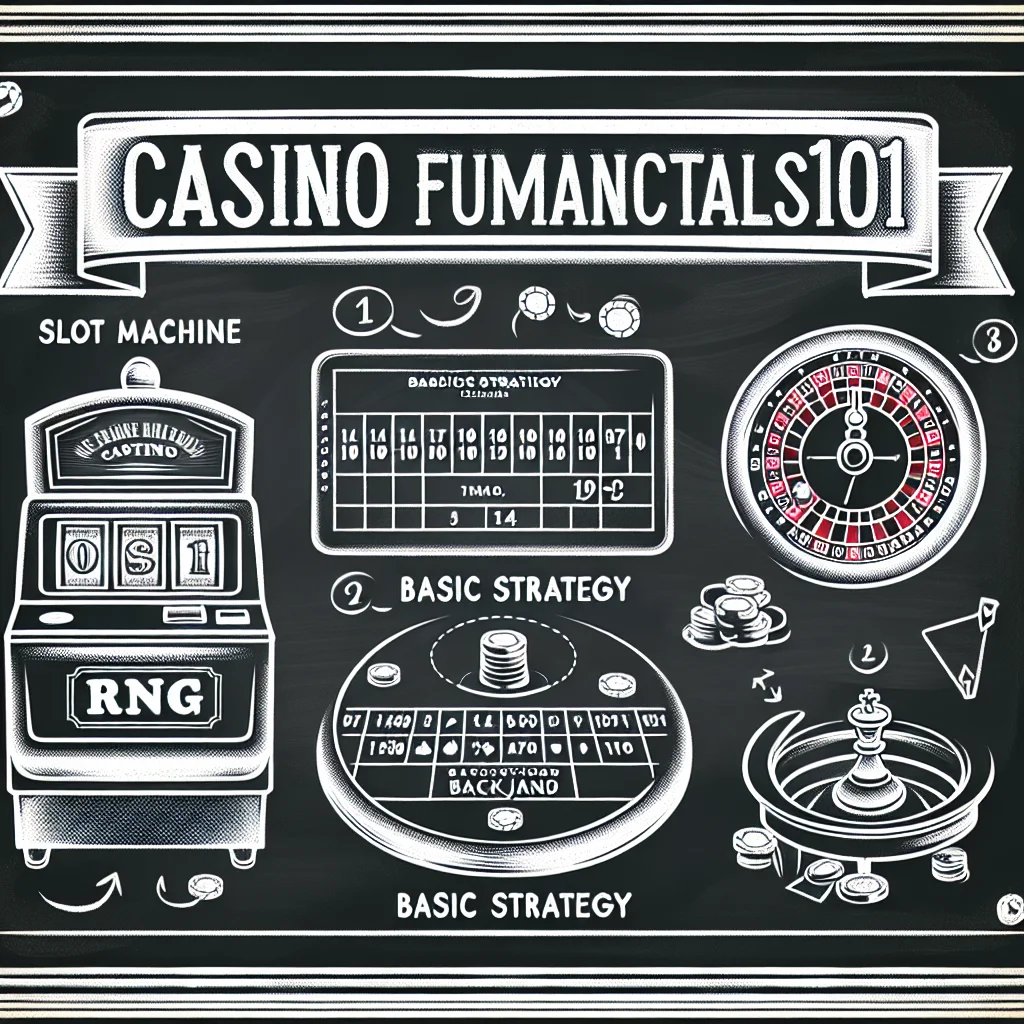
Welcome to Casino Fundamentals 101
Consider this your introductory course to the world of casino gaming. Just as you wouldn’t attempt calculus without first learning algebra, diving into casino games without understanding their core fundamentals is a setup for confusion and rapid loss. This guide is designed to be your syllabus, covering the essential principles you need to know before you place your first real bet. We will dissect the three most prevalent casino games—slots, blackjack, and roulette—through the lens of their underlying mechanics and basic strategic concepts. Our goal is not to turn you into a professional gambler overnight, but to equip you with the intellectual tools to be an informed participant. By the end of this “course,” you will understand the “why” behind common advice, enabling you to make deliberate choices, manage your expectations, and fundamentally change how you interact with the casino environment. Let’s begin Lecture 1 by addressing the most critical prerequisite: your mindset and money.
Lecture 1: The Core Principle – House Edge and Bankroll
Before we examine specific games, you must understand the two universal fundamentals that govern all casino play: the House Edge and Bankroll Management. The House Edge is the mathematical advantage the casino holds over the player in any game, expressed as a percentage of each bet that the casino expects to keep in the long run. It is not a guarantee on every bet, but a statistical certainty over millions of wagers. For example, a 5% house edge means that for every $100 wagered, the casino expects to keep $5. This edge is built into the rules of every game. Your goal as an intelligent player is not to eliminate the house edge (impossible in the long run), but to choose games and strategies that minimize it. The second fundamental, Bankroll Management, is your personal defense system. Your bankroll is the total amount of money you have allocated for gambling. Intelligent management means treating this bankroll as the cost of entertainment. The fundamental rule is to never gamble with money you cannot afford to lose. From your total bankroll, you create session bankrolls—smaller amounts for individual playing periods. A key principle is the “5% Rule”: never risk more than 5% of your session bankroll on a single wager or spin. This discipline ensures that normal losing streaks don’t wipe you out and allows you to enjoy the entertainment you paid for. These two concepts are the bedrock upon which all other strategies are built.
Lecture 2: Slots – Understanding Randomness and Return
Slot machines are the most popular casino game, and their fundamentals revolve around software, not mechanics. The first concept to master is the Random Number Generator (RNG). This is a computer program that cycles through millions of number combinations continuously. When you press spin, it stops on a combination that determines the reel positions. The crucial takeaway is that each spin is an independent, random event. The machine has no memory. This debunks the “due for a win” myth. The second fundamental is Return to Player (RTP). This is the theoretical percentage of all wagered money a slot machine will pay back to players over its lifetime. An RTP of 96% means the game is programmed to return $96 for every $100 wagered, keeping $4 as the house edge. You can often find this in the game’s information menu. The third fundamental is Volatility (or Variance). This describes the risk profile of the game. Low volatility slots pay out small wins frequently, leading to longer, steadier sessions. High volatility slots pay out less often but have the potential for larger jackpots, leading to more dramatic bankroll swings. As a beginner, your intelligent play is to seek out games with a higher RTP (96%+) and lower volatility. When you play, use your bankroll management fundamentals: bet small to extend play, set a loss limit for the session, and view any bonus features or wins as part of the entertainment experience, not an expected return on investment.
Lecture 3: Blackjack – The Fundamentals of Decision-Based Play
Blackjack is unique because it’s a game where your decisions directly influence the odds. The fundamental concept here is Basic Strategy. This is a predetermined set of actions (hit, stand, double down, split) that tells you the mathematically optimal play for every possible combination of your hand and the dealer’s upcard. It was derived from computer simulations analyzing millions of hands. Learning Basic Strategy is not a tip; it is the core curriculum for blackjack. It reduces the house edge to as low as 0.5% with favorable rules, compared to over 2% if you play by gut feeling. Start by memorizing the most common situations: always stand on 17 or higher; always hit on 11 or lower; double down on 11 against a dealer’s 2 through 10; and never take insurance. The second fundamental is rule variation. Not all blackjack games are created equal. The most important rule to check is the payout for a natural blackjack. You want “3:2” (you win $3 for every $2 bet), not “6:5,” which increases the house edge substantially. Other favorable rules include the dealer standing on soft 17 and the availability of surrender. Your intelligent play is to find a table with the best rules your bankroll allows, use Basic Strategy religiously, and employ flat betting (wagering the same amount each hand) to manage variance. This disciplined, fundamentals-based approach is the hallmark of a smart blackjack player.
Lecture 4: Roulette – Mastering Probability and Bet Types
Roulette is a pure game of chance, making probability the central fundamental. The first lesson is in wheel geometry. A European wheel has 37 pockets (1-36 and a single 0). An American wheel has 38 pockets (1-36, 0, and 00). This extra double-zero pocket is critical; it increases the house edge from 2.7% on European to 5.26% on American roulette. Your first intelligent decision is always to play European roulette. The next fundamental is the classification of bets. Bets are either “Inside” (on specific numbers or small groups) or “Outside” (on large groups like red/black or odd/even). Each bet has a precise probability and payout. For a European wheel, a straight-up bet on a single number has a 1 in 37 (2.7%) chance of winning and pays 35:1. An even-money outside bet on red has an 18 in 37 (48.6%) chance of winning and pays 1:1. The green zero is the source of the house edge on all non-zero bets. For intelligent play, your fundamental strategy is to focus on outside bets. They offer the highest probability of winning any individual spin, which aligns with good bankroll management by providing more playtime and less volatile swings. Avoid progressive betting systems like the Martingale. They cannot change the independent probability of each spin and can lead to rapid, significant losses. Instead, use your bankroll fundamental: make small, consistent even-money bets and enjoy the social and theatrical aspects of the game. Roulette is a game to experience, not to conquer through complex systems.
Final Exam: Synthesizing Fundamentals for Your First Visit
Now, let’s apply everything you’ve learned in Casino Fundamentals 101 to a practical final exam: your first intelligent casino visit. Step 1: Preparation (Apply House Edge & Bankroll Fundamentals). Determine your total entertainment budget. Divide it into two session bankrolls. Print a Basic Strategy card for blackjack. Step 2: Game Selection (Apply Game-Specific Fundamentals). Upon arrival, scout. For slots: look for machines with familiar, fun themes, avoiding high-stakes progressive machines. For blackjack: find a 3:2 payout table with a low minimum bet. For roulette: locate a European wheel. Step 3: Execution. Choose one game for your first session. Buy in for your pre-determined session bankroll amount. Slots: Bet the minimum per line, set a loss limit (e.g., 50% of credits), and play for fun. Blackjack: Bet the table minimum, use your Basic Strategy card for every decision, and ignore other players’ advice. Roulette: Exchange cash for chips, place small bets on red/black or odd/even only. In all cases, adhere to the 5% Rule per wager/spin. Step 4: Session Control. Set a timer for 45 minutes. When it goes off, cash out regardless of outcome. Take a 30-minute break. Assess. Step 5: Review. Did you follow the fundamentals? Did you enjoy the process more because you understood it? This is the true measure of success. By synthesizing these fundamentals—house edge awareness, strict bankroll management, and game-specific intelligent play—you pass this course with flying colors, ready to explore the casino world not as a naive hopeful, but as an informed, strategic participant.